Cash, cards and the stuff in between.
Japan has a reputation for being cash-only and confusing. It isn't anymore. Here's exactly how we paid for a near-three-week family trip. It covers the short list of jobs worth doing at home before you fly, what we used cash for, what we tapped a card for, how the kids' IC cards doubled as pocket money, and the small mistakes that are easy to avoid.
We travelled in September. Money rules and rates move, so we've kept the numbers loose and flagged anything time-sensitive. The 2026 changes in section IX are researched rather than lived, and were checked in August 2026.
Carry both, lean on neither.
Japan used to run on cash. That story is out of date. Cards now work in the convenience stores, the big chains, department stores, hotels and most city restaurants. For a family, one bank card plus an IC card covers the overwhelming majority of what you'll spend.
But cash hasn't vanished. Small family-run restaurants, especially the ones where you order from a ticket machine at the door, temples and shrines, market stalls, festivals and the odd rural spot are still cash or IC only. The fix is simple. Keep some yen on you and you'll never be the family holding up the queue.
Our own rhythm was easy. Cash for the small everyday stuff, a card for the bigger tickets. First, though, the handful of jobs worth doing before you leave home.
Six jobs, and when to do them.
Almost none of this is difficult. It is a short list of small jobs that are easy at your kitchen table and genuinely annoying from a hotel room eight time zones away. Here is what actually has a deadline, in the order the deadlines arrive.
Insurance is the one you cannot do late. A travel policy does two separate jobs. The medical half matters from the moment you land, so buying late does not weaken it. The cancellation half works backwards. It covers you from the day the policy starts until you go, which is precisely the stretch where illness, injury and family emergencies actually turn up. Which insurer, and what a family policy really covers, get a whole guide of their own, travel insurance for Japan.
Buy the travel insurance
The only item here with a deadline you cannot move. Cancellation cover starts when you buy the policy, not when you fly, so a policy bought the week before departure has quietly skipped the months when most cancellations actually happen.
Check the cards, not just the balance
Expiry dates, PIN length, and whether your bank can still reach you abroad. All three are five-minute jobs at home and genuinely awkward to fix from a hotel in Osaka.
Decide on a rail pass, or decide against one
Not because it is urgent, but because the price moved this year and the cheapest window for buying one is not open forever. Work out whether your route even justifies a pass first.
Buy the eSIM and the adapter
Both cost more at the airport than they do at home, and the eSIM is the thing that keeps your bank able to text you. Order the eSIM a few days early so you can install it without a queue behind you.
Fill in Visit Japan Web
Free, official, and it turns immigration and customs into one QR scan at the big airports. Screenshot the code before you fly rather than trusting airport wifi to load it.
Sort the landing float and split the cards
A small amount of yen to land with, and your two cards in two different bags. That is the whole job. Everything else can be done from a convenience store on day one.
Four checks, five minutes.
Japan takes cards far more happily than its reputation suggests, so the risk is not really that cards do not work. It is that one specific card stops working on a Saturday night and you have no second plan. These are the four things worth confirming while you are still standing in your own kitchen.
Two cards, two networks, two banks
One card is a single point of failure. Take a second on a different network and ideally a different bank, and keep it somewhere other than the first. Visa and Mastercard are the ones that reliably work here, so if your favourite card is an Amex, make it the backup rather than the whole plan.
A four-digit PIN
Japanese cash machines are built around four digits. A six-digit PIN is a common reason a perfectly good foreign card gets refused. If yours is longer, ask your bank to change it before you fly, because that is not something you can fix quickly from overseas.
Expiry dates past your return
A card that expires mid-trip is an obvious problem and an easy one to miss when the expiry is months away at the time you book. Check every card in every wallet, including the kids’ if they carry one.
A phone number your bank can actually reach
When a payment gets flagged, the bank sends a code to the number on file. If that number is unreachable because you swapped the SIM out, the card stays blocked until you find wifi and a way to call an international support line. More on avoiding that below.
Ringing the bank is mostly obsolete.
The advice to phone your bank before you travel has been passed down so many times that it now outlives the thing it was for. Several of the largest card issuers have stopped taking travel notices altogether, because their fraud systems read the transaction pattern rather than a note on your file. Others still ask for one. There is no universal answer, which is why the only sensible move is thirty seconds in your own banking app rather than a rule you read on a blog.
The genuinely useful version of this job is different, and almost nobody mentions it. When a payment does get flagged, the bank resolves it by contacting you. That means a text, a push notification or a call to the number they hold. So the question is not whether they know you are in Japan. It is whether they can reach you once you are.
This is the quiet reason an eSIM belongs on a money page. If you pull your home SIM out and drop a Japanese one in its place, your bank’s verification text goes to a phone number sitting in a drawer at home. An eSIM sidesteps it. The Japanese data plan loads alongside your existing number instead of replacing it, so a blocked card can be sorted out from a train platform in about a minute.
Two small things finish the job. Turn on push notifications for card transactions before you fly, so a decline explains itself instead of being a mystery. And save your bank’s international number somewhere offline, because the number printed on the back of a card is not much help when the card is the thing you have lost.
An eSIM and an adapter, in that order.
The eSIM
We used an Airalo eSIM on two phones, mine and Lyndsie's, with a big data plan for the whole trip. It worked the whole way through, from Osaka to Tokyo, and we'd use Airalo again. The boys didn't have their own data.
Buy it a few days before you fly rather than at the airport. Not because it sells out, but because installing one involves a QR code, a settings menu and occasionally a support email, and none of that is improved by doing it at a boarding gate. Most providers let you pick the activation date, so you can set it up calmly at home and have it wake up when you land.
The reason it sits on a money page rather than a packing list is the one from section III. An eSIM adds Japanese data without evicting your existing number, which is what keeps your bank able to text you when a card gets flagged. A physical Japanese SIM that replaces your home SIM quietly breaks that.
Size it to how you travel rather than to the biggest number on the page. A family navigating, translating and posting photos is doing normal phone things, not streaming. If you plan to hotspot a laptop, that is the case for an unlimited plan.
The eSIM we used. Airalo on both our phones for the whole trip, and we would use it again. On most Airalo plans the days only start counting once it connects in Japan, so you can install it at home. Check the validity policy on the plan you pick.
The adapter
Japan runs on 100 volts through the flat two-pin socket the US and Canada use, so North American travellers frequently need nothing at all. Everyone else, the UK, Europe, Australia, New Zealand and Singapore included, needs a plug adapter. It is a cheap part that costs several times more once you are standing in an airport holding a flat phone.
You almost certainly do not need a voltage converter. Look at the small print on the charger itself. If it says 100 to 240 volts, which phone, laptop, tablet and camera chargers essentially always do, a plug adapter is the whole job. The exceptions are single-voltage, high-draw things, and hair dryers and styling tools are the usual suspects. Japan’s 100 volts is also a little lower than most of the world, so a device that technically works may simply run weaker than it does at home.
One adapter per family is a false economy. Four people with phones, plus a tablet and a camera, is a queue at a single socket every night. A small multi-port charger on one adapter solves it in one go.
Use the convenience-store ATMs.
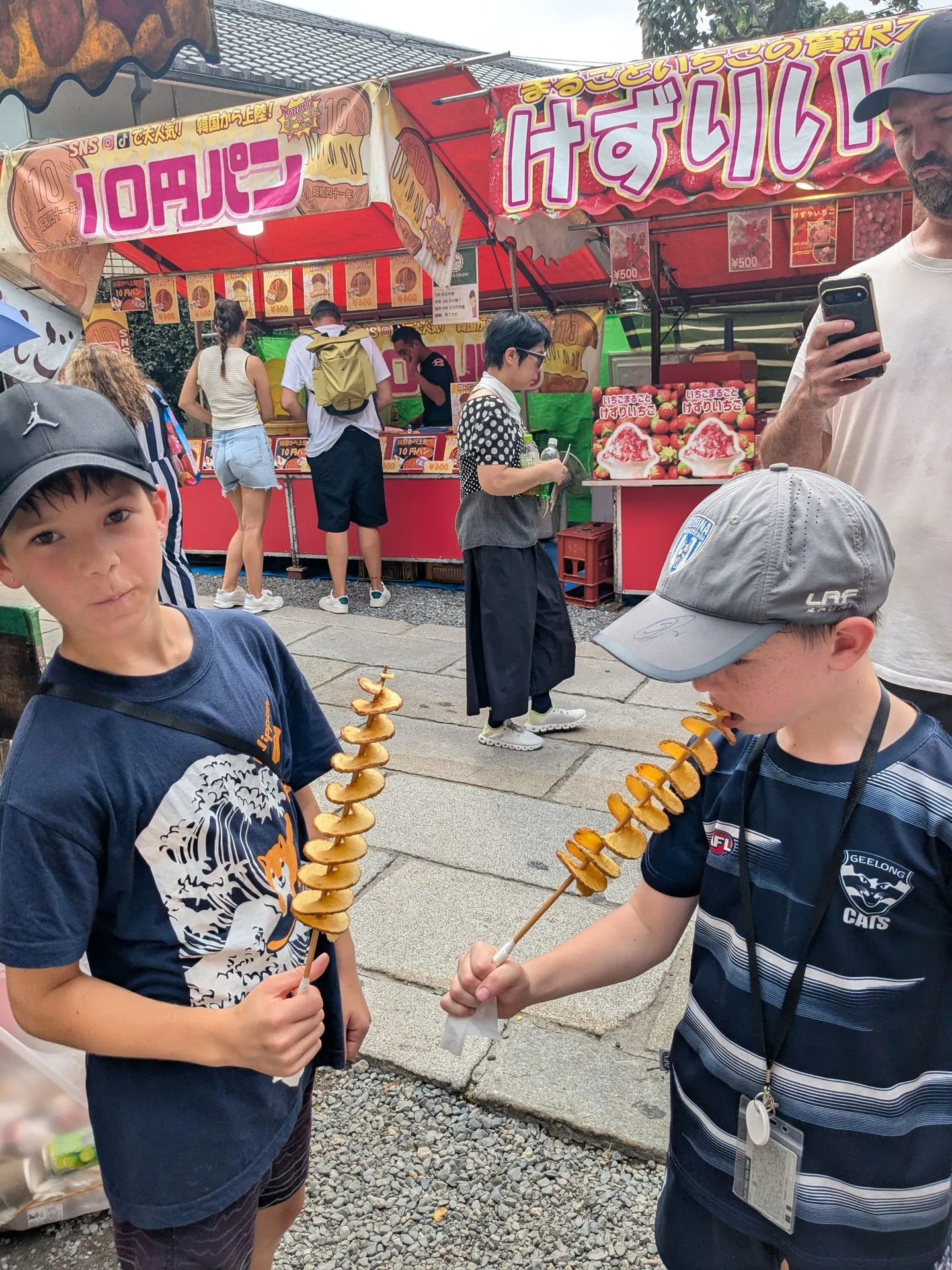
We pulled cash out as we went rather than carrying a big stack, and almost always at a 7-Eleven. They are on practically every corner, open around the clock, and the machine switches to English with one tap.
The two networks that reliably take foreign cards are 7-Eleven (Seven Bank) and Japan Post, the latter handy out in the countryside. A lot of local bank ATMs will simply reject an overseas card, or only work in business hours, so don't gamble on a random machine when a konbini is usually a minute away.
Two things to expect. There's a small withdrawal fee on top of whatever your home bank charges, so take out a sensible chunk rather than tiny amounts over and over. And if the screen asks whether to bill you in Australian dollars or yen, choose yen (see the next section for why).
Visa or Mastercard, tapped.
Day to day we ran a simple split, cash for the little things and card for the bigger ones. Restaurants, hotels and the larger shops all went on a Visa or Mastercard, usually tapped straight from Google Pay on our phones. Contactless is normal now in the cities.
Stick to Visa or Mastercard. They're accepted almost everywhere a card is taken. Amex is patchier, so don't make it your only card. Carry two cards on different networks and a little cash, and you've got a fallback for the rare terminal that's fussy.
One habit is worth drilling in. Whenever a terminal or ATM asked if we wanted to be charged in Australian dollars instead of yen, we always said no and paid in yen. Paying in your home currency sounds helpful but quietly bakes in a worse exchange rate. Always choose the local currency.
The card that's also a wallet.
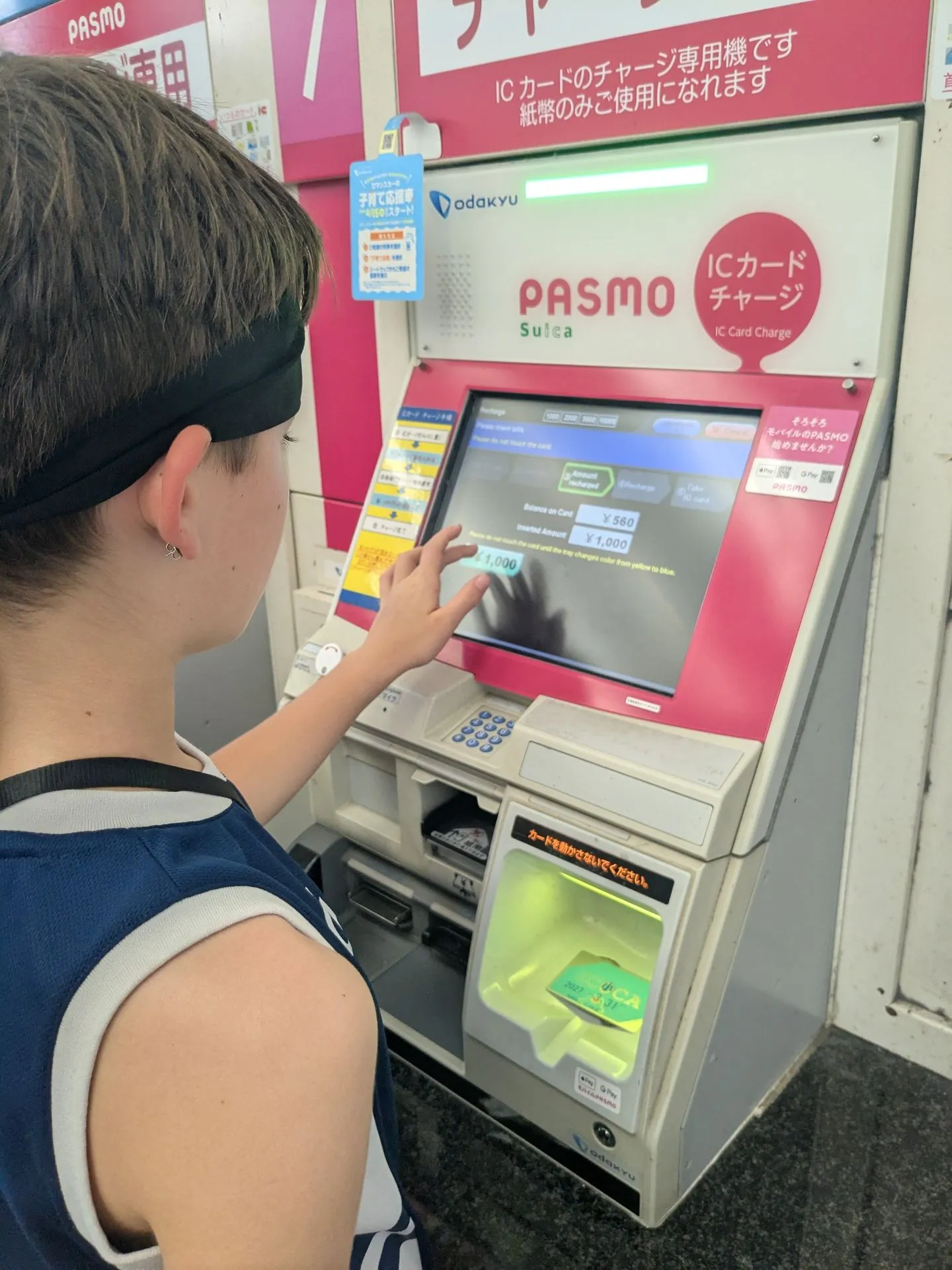
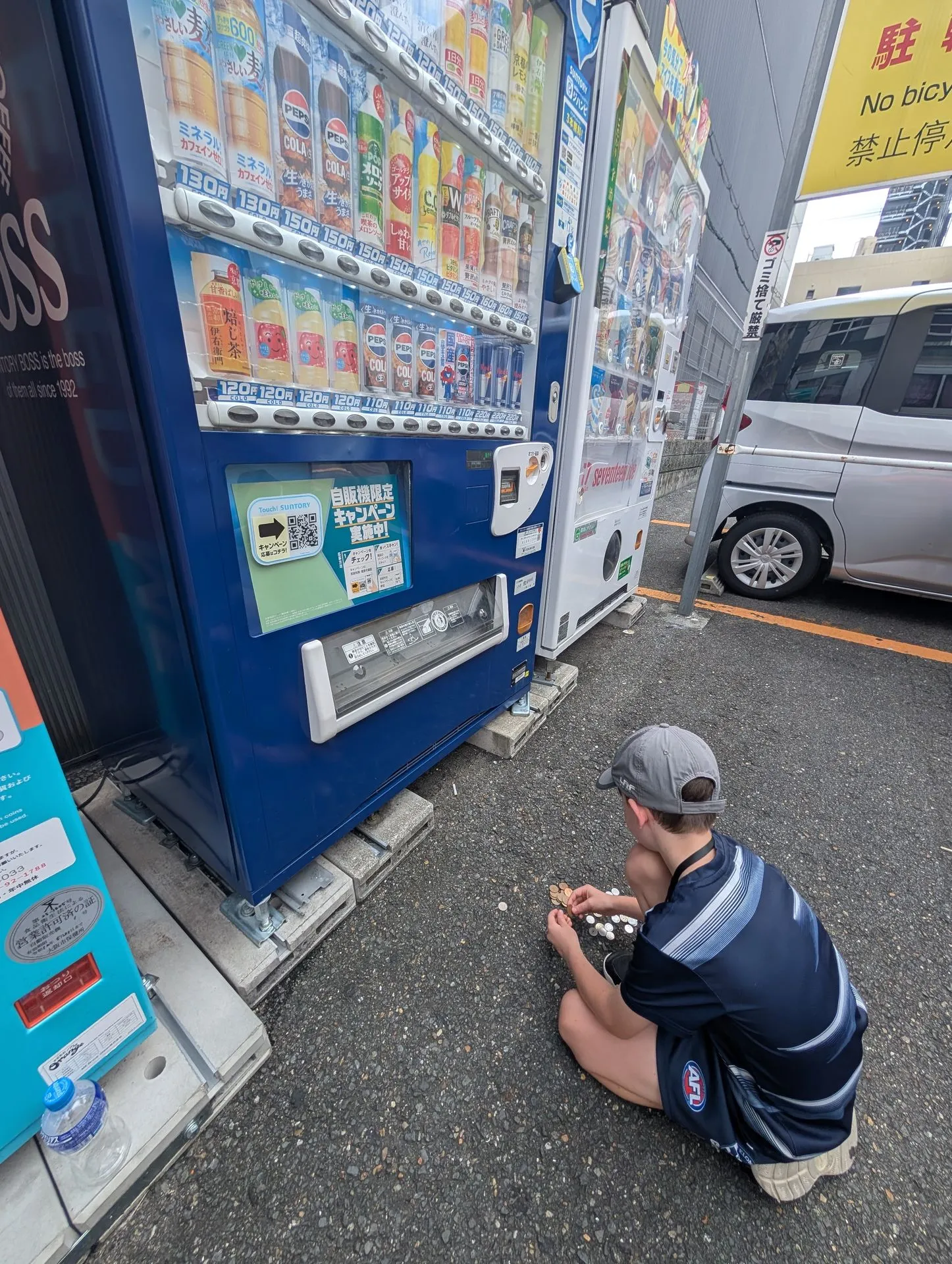
A Suica, Pasmo or ICOCA is a prepaid tap card for trains and buses, but here's the bit people miss. It also pays at vending machines, convenience stores, lockers and plenty of shops. It's the single most useful thing in a family's pocket.
We went with physical cards, and for us that wasn't really a choice. We're a Google Pixel family, and a foreign Android phone can't load a mobile Suica (that trick needs Japanese hardware, and the Apple Wallet version is iPhone only). Honestly, physical was better for the kids anyway. We popped a card in each boy's lanyard and they tapped themselves through every gate.
Top-up is the one catch. Reloading a physical card at a station machine is usually cash only, so keep a few notes back for it. And each card maxes out at ¥20,000, which is plenty for daily spending.
For the kids, children aged six to eleven ride at half fare on a child IC card, but you have to buy those at a staffed ticket counter with the child's passport, not from a machine. Under-sixes travel free.
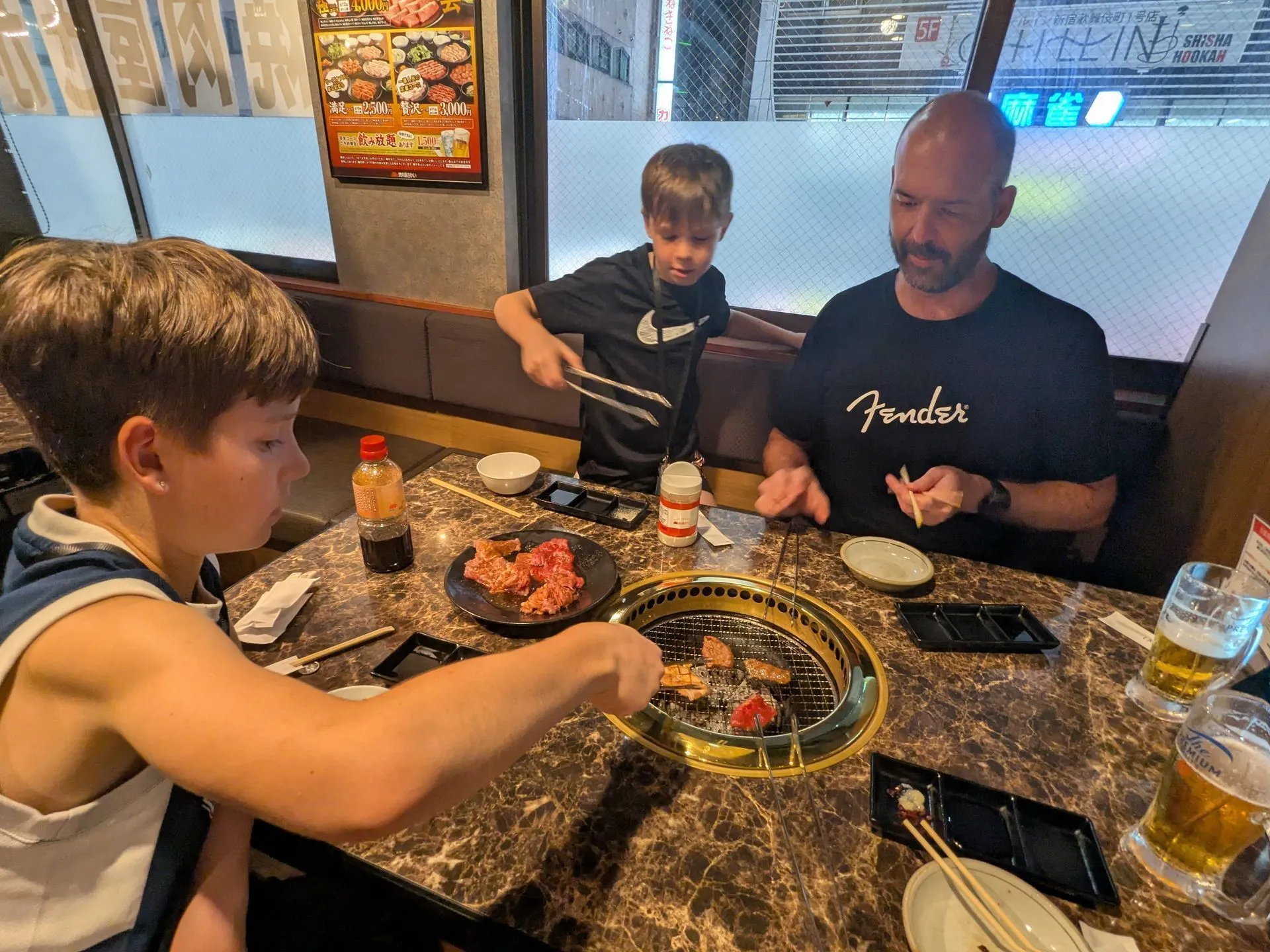
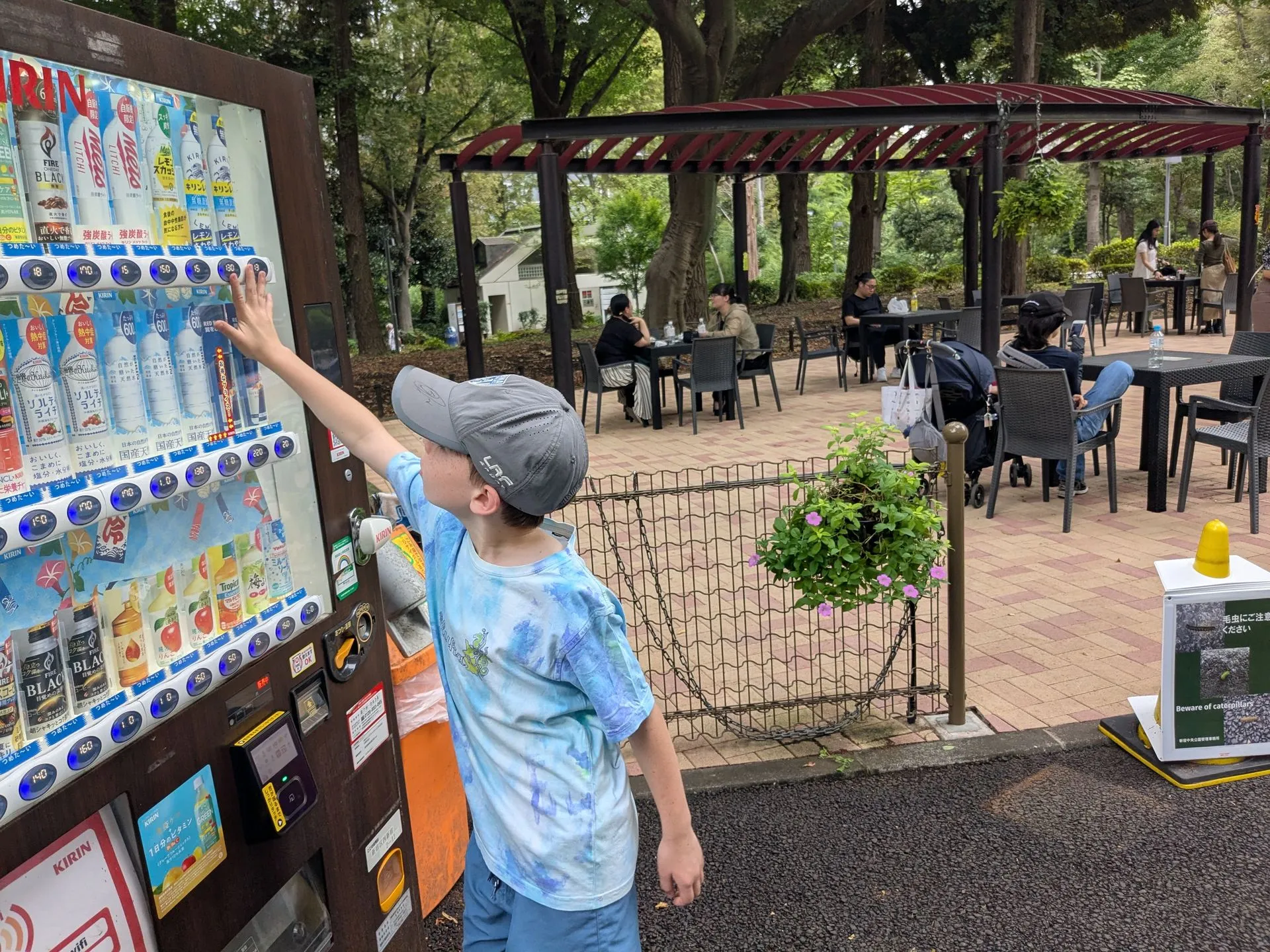
Here's our favourite money moment of the trip. We never told the boys their "train cards" worked anywhere else. On the last morning we let them in on the secret and turned them loose to spend whatever was left on the balance. Two kids, a row of vending machines, and the most thrilling shopping spree of their lives.
Don't change money at the airport back home.
The exchange booth at your home airport is almost always the worst rate going. You can order yen before you leave for convenience, but you pay for that convenience in the rate. We didn't bother. We just landed and withdrew our first yen from a 7-Eleven, then topped up as we went.
A modest float is still worth having, because arriving with nothing means your first interaction in a new country is a queue at a cash machine with two tired kids. Enough for a train fare, a taxi if the trains have stopped, and a convenience store run is the right size. Land with a float, not a fortune.
A multi-currency travel card like Wise or Revolut is a tidy option too. They hold yen at close to the real exchange rate and give you a few low-fee ATM withdrawals, which beats airport counters comfortably. If you go with Revolut, just note its weekend exchange surcharge and time top-ups for weekdays.
One bit of good news for travellers from Australia, the UK and the US is that the yen has been weak for a while, so Japan has felt genuinely good value. Rates move, so check today's before you read too much into any number.
Four costs that moved this year.
None of these will change whether you go. Together they are worth a few hundred dollars to a family of four, and three of the four are invisible until they have already happened to you. We travelled before all of them, so this section is desk research rather than experience, and we have flagged the bits the authorities had not published yet.
We didn't chase tax-free shopping ourselves, the family budget went on experiences, not gadgets. But tourists can claim back Japan's 10% consumption tax on bigger purchases, so if you're eyeing electronics, cosmetics or a department-store haul, the last change below is real money worth knowing about. Bring your passport, it's required either way.
The departure tax tripled
Japan’s international tourist tax went from ¥1,000 to ¥3,000 per person. It applies to almost everyone leaving the country by air or sea, visitors and residents alike, from age two up. You do not queue to pay it. Airlines and ferry operators collect it inside the ticket price, which is exactly why it is easy to miss. For a family of four it is ¥12,000 already sitting in your airfare.
Kyoto’s accommodation tax jumped
Kyoto now runs the steepest lodging tax in the country, banded by room rate. Cheap rooms attract a couple of hundred yen a night. The top band reaches ¥10,000 per person per night, which is a luxury-hotel problem rather than a family-apartment one. The part worth knowing is that this is usually charged at the property, so it may not appear in the total you saw when you booked online. Other prefectures have added or raised their own, mostly in the ¥100 to ¥500 range.
The nationwide Japan Rail Pass got dearer
The seven-day ordinary pass moved from ¥50,000 to ¥53,000, the fourteen-day from ¥80,000 to ¥84,000 and the twenty-one-day from ¥100,000 to ¥105,000, with green car and child fares rising in step. JR has said pre-October prices will stay available on the official rail pass website for a limited period, but when we checked it had not published how long that window runs. If a pass is part of your budget, price it on the official site and take the answer on the day rather than from us.
Tax-free shopping becomes a refund, not a discount
Until this date you show a passport in store and simply pay less. After it, you pay the full price including the 10% consumption tax and claim the money back on the way out of the country. The ¥5,000 minimum spend in one shop on one day is unchanged, and the old split between general goods and consumables disappears, so a mixed basket can now be added together to clear the threshold. You then have 90 days to leave and complete the check at the airport, or the refund lapses. The exact refund mechanics, including how and where the money comes back, were still being finalised when we wrote this, so treat the process as settled and the detail as not.
Figures as published and as we understood them in August 2026. Taxes and pass prices move, and the tax-free refund process in particular was still being finalised, so confirm anything you are budgeting against before you rely on it.
Quick answers to the worries.
The same handful of money questions come up before every first trip. Here's our honest take on each.
- Do you tip in Japan?
- No. Tipping is not a thing here, and leaving money can cause confusion rather than gratitude. Good service is simply the standard. Keep your coins.
- Is it safe to carry cash?
- Yes. Japan has some of the lowest street crime in the world, and a famously honest lost-and-found culture. We never once felt nervous carrying yen. Use the usual common sense, but a cash-heavy day is genuinely low stress here.
- How much yen should we land with?
- Enough for a train, a taxi and a convenience store run, not a week of spending. You are landing at an airport with cash machines that take foreign cards, so there is no reason to carry a big float through two flights. Top up properly once you are in the country.
- Do I need to tell my bank I am going to Japan?
- Probably not, and this advice has genuinely changed. Several of the biggest card issuers have dropped travel notices entirely and lean on fraud detection instead, while others still suggest you flag a trip. Check your own bank’s app rather than assuming either way. The job that replaced it matters more. Make sure the bank can reach you by text or call while you are away.
- Can the kids use their IC cards as money?
- Yes, and this delighted ours. A Suica, Pasmo or ICOCA works at vending machines, convenience stores and loads of shops, not just train gates. Let them spend the leftover balance on the last day.
- What do I do with all the coins?
- They pile up fast. Vending machines are the cure, they take coins happily and they are everywhere. The kids treated them as a game. You can also load loose change onto an IC card.
- Can I pay with my phone?
- Tap-to-pay with Google Pay or Apple Pay works at most card terminals. Just know that a foreign Android phone cannot load a Suica (that needs Japanese hardware), so you still want a physical IC card for the trains.
- Which ATMs take foreign cards?
- Default to 7-Eleven (Seven Bank) and Japan Post. They reliably accept overseas cards, run around the clock and switch to English. Plenty of local bank ATMs will refuse a foreign card, so do not rely on a random machine.
- Do I need a travel adapter for Japan?
- That depends where you are coming from. Japan uses the flat two-pin Type A socket, so travellers from the US and Canada often need no adapter at all, while anyone from the UK, Europe, Australia, New Zealand or Singapore does. Buy it at home. Airport prices for a two-dollar part are a well-established tax on the unprepared.
- Do I need a visa or a JESTA to visit Japan?
- Most Western passport holders need neither for a short holiday. Japan has approved an electronic travel authorisation called JESTA, but it is not due until the 2028 financial year at the earliest. Any site charging you for a Japan travel authorisation today is not an official government service. Visit Japan Web is the real system, and it is free.
- When should I buy travel insurance for Japan?
- The day you book the flights. Medical cover matters from the moment you land, but cancellation cover only protects you from the day the policy starts, so buying late means paying for a benefit you have already spent months without.
Plan it the way we would.
We planned this trip ourselves, paid for it ourselves, and wrote down what worked and what did not. All of it is on the site, free, with nothing to sign up for.
- Where to go, and how long to give each place
- What to book ahead, and what to skip
- Getting around with kids, without the guesswork
- What it actually cost us
The planning guides
Flights, trains, money, food, insurance and where to stay. Written after the trip, not before it.
Read the guides → Browse destinations